

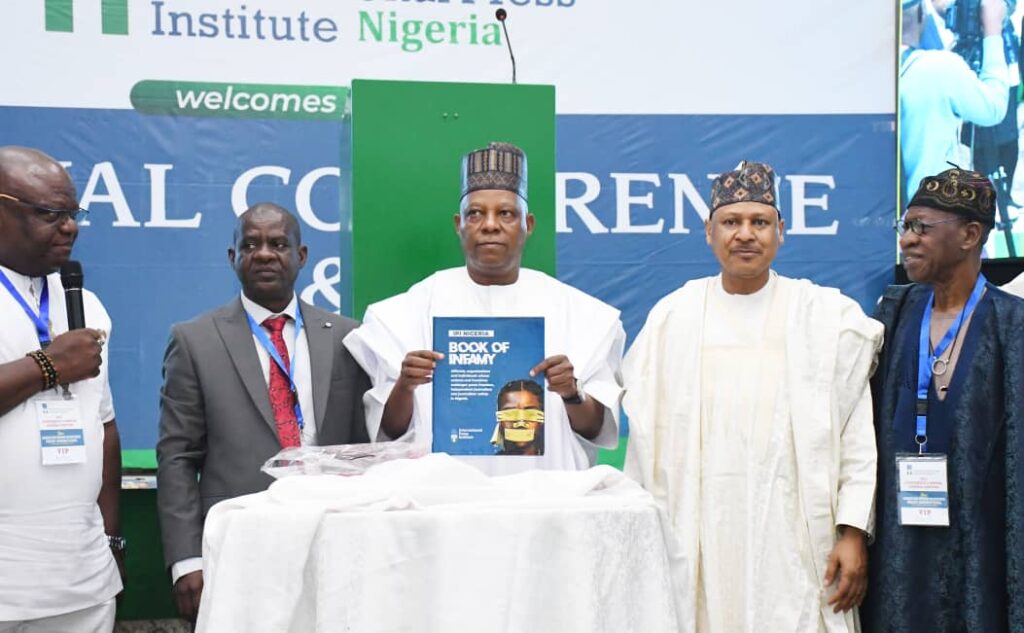
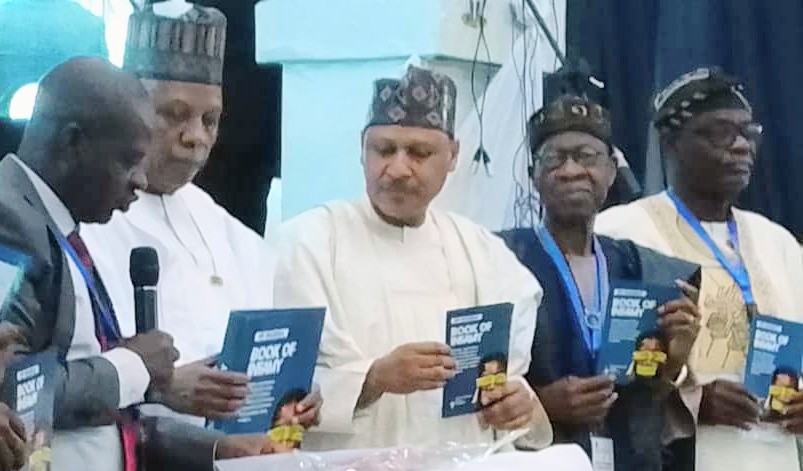
In their bid to reverse deteriorating press freedom situation, members of the Nigerian Chapter of the International Press Institute (IPI Nigeria) on Tuesday in Abuja unveiled the ‘Book of Infamy’ during their 2025 Conference and Annual General Meeting (AGM), holding at NICON Luxury Hotel, Abuja.
The IPI Nigeria described the “Book of Infamy” as a special publication that will document cases of media repression and press freedom violations in Nigeria.
It is one of IPI Nigeria’s accountability tools, an instrument for documenting and exposing individuals and institutions that, through their actions or neglect, harass, arrest, intimidate, or otherwise, violate the fundamental rights of journalists and media organisations.
It will also spotlight public officials, security operatives, private individuals, and organisations whose conduct undermines press freedom in Nigeria.
Although the IPI Nigeria had listed the Inspector General of Police, IGP Olukayode Egbetokun and the Governors of Akwa Ibom State, Imo Eno and Niger State, Mohammed Umar Bago as the first names to enter its Book of Infamy, Vice President Kashim Shettima, who witnessed the unveiling of the book, sought a two-week moratorium to enable him reach out to all those accused of breaching the rights of Journalists with a view to resolving the issues.
He invited the President of IPI Nigeria, Musikilu Mojeed to travel with him to Akwa Ibom State, where he would be visiting soon, to resolve the issue between Governor Eno and Channels Television.
While Egbetokun was said to have failed to heed the calls by IPI to stop the arbitrary arrests of Journalists nationwide by his operatives, Eno barred the crew of Channels TV from covering the activities of the Akwa Ibom State Government House and Bago ordered the closure of Badeggi FM, a private radio station.
Also at the event, IPI Nigeria bestowed special honour on the Director General of the Department of State Services (DSS), Adeola Oluwatosin Ajayi for the removal from the government’s watchlist of the Executive Director of the International Press Centre, Lanre Arogundade, after 40 years and the quick release of Journalists who were wrongly arrested by the secret police.

The institute also served notice of the intention to henceforth resist acts of repression and violation of freedom of expression in any part of the country.
Welcoming members and guests to the 2025 Annual Conference and Annual General Meeting of the International Press Institute (IPI Nigeria), the President of the institute, Musikilu Mojeed said professional journalists will no longer fold their arms and watch the decline in media freedom.
Mojeed’s statement followed Nigeria’s slide by 10 places to 122nd in the 2025 World Press Freedom Index released by Reporters Without Borders (RSF), a sharp drop from its 112th position in 2024.
According to him, the Nigerian media landscape is in distress as a result of the cumulative effect of consistent and aggressive repression across some States, platforms, and newsrooms.
“Nigeria is classified as one of West Africa’s most dangerous and difficult countries for journalists. This is not a beautiful portrayal of our country, but the description is not baseless.
“The pattern is unmistakable: Journalists are monitored, attacked, and arbitrarily arrested: Completely lawful reporting activities (filming a demolition, covering a protest, documenting police misconduct) have become dangerous acts.
“Media houses are shut down for political reasons: In Zamfara, four (4) broadcast stations (NTA, Pride FM, Gamji TV, and Al-Umma TV) were once closed simply for airing an opposition rally.
“Investigative journalists face targeted intimidation: We recall the harrowing experience of a colleague, Segun Olatunji, who was abducted, blindfolded, chained, and transported hundreds of kilometres away from his base for a controversial reporting.
“Online reporters are now frequent victims of cybercrime accusations: The cybercrime law, despite recent amendments, continues to be used to suppress digital journalism. Several journalists have been arrested or prosecuted under this legislation.”
The President of IPI Nigeria noted the vulnerability of journalists on election coverage duties, investigative reporters, and those engaged in digital journalists, adding that they have been at the receiving ends most of the time.
He lamented that no less than 56 journalists were assaulted or arrested while covering demonstrations across the country in August 2024 alone, and blamed state agents, political actors, and security operatives who operate with impunity.
“This has been said before, and I will say it again: Journalism is not a crime. And journalists are not criminals. The Constitution protects freedom of expression. The courts have affirmed it. But in practice, we continue to see arbitrary arrests, intimidation, censorship, and violence.
“Therefore, any further attack on journalists will be fiercely resisted going forward,” he concluded.
